
True ‘Customer’ insight

True ‘customer’ insight  is a hot topic around boardroom tables, but often subsequent to a review of financial performance.  Strategic thinking involves understanding the perceptions and intentions of many stakeholder groups in order to create value propositions and engagement strategies. Failure to deliver perceived value to ‘customers’ tends to negatively impact the ability to deliver value to any other group of stakeholders. 

Who is the customer?

The first challenging question.  Determining who you want to provide value to may involve modifying the market segments you target. Identifying the customers you don’t want to serve is also critical. Consider inviting these elegant but invasive Green Parakeets into your garden and watch the small birds leave.

Who knows?

Decisions on who to target need to be informed by evidence so critical questions include ‘ how can we hear our customers first hand? And ‘who knows the history, perceptions and intentions of each customer?’

Who listens?

Consultancies and academic researchers have advocated an increased exposure of executive committees and boards to customers who reinforce organisational beliefs AND those that challenge assumptions. Listening to perceptions first hand can be educational but also uncomfortable.

Boundary workers with unique insights to share need to be invited to speak directly to strategic decision makers and supplement the real voices of customers. The voices of those who know may be filtered out before they reach the boardroom. 

Reliance on Big Data without the addition of human intelligence can lead to misinformed strategic decision making. Sifting messages from noise and recognising patterns is a critical board competence. 

Creating opportunities to listen to customers and boundary workers may require ‘Leading by Wandering About’ as opposed to MBWA (Managing by Wandering About). Physical and virtual wandering about are habits cultivated by effective directors and enabled by governance professionals.

What happens 

If you engage in conversations with customers, you build an expectation that change will happen. You also build an expectation that the conversation will continue. This presents challenges in establishing who is responsible and accountable for deciding and delivering changes and how performance and perception of value delivery will be monitored. 

Ensuring that change is visible and supported by necessary hard wiring and soft wiring of your organisation involves adopting systems thinking, understanding the inter-connectivity of all parts of your organisation.

Establishing which stakeholders are consulted before strategic decisions are taken and which stakeholders are informed after decisions are made, provides the foundation for an effective engagement strategy. 

So now after a year of courting a charm of Goldfinches to our garden, I am off to persuade the Green Parakeets to move on.


Non-Executive Director – insights

Recent discussions with experts and practitioners provide pragmatic advice for clients and candidates:

The opportunity

Client advice:

1. Take succession seriously.

2. Think carefully about what you need to make you ‘fit for the future.’

3. Prepare your role and person specifications thoughtfully – don’t create in your own image.

4. Pick the head-hunter not the firm.

Candidate advice:

1. Establish your personal risk appetite.

2. Get on the radar of the sectors/organisations you are interested in and the people who can open doors – public and third sector advertise but private sector opportunities are not always transparent.

3. Pick carefully – conduct due diligence on the board, chairman and organisation. Identify ownership, board structure, composition, processes and dynamics.

4. Find people to endorse you so that you get through the initial sift.

The selection

Client advice:

1. Schedule search and selection realistically

2. Build on your board rhythm to take advantage of existing events and access to key decision makers.

3. Respect all candidates – they will share their experience.

Candidate advice:

1. Research and prepare properly – currency is important.

2. Position your capability against the specification.

3. Experience board dynamics in action – how do the Chairman and Chief Executive interact?

The transition

Chairman and new NED advice:

1. Tailor on-boarding processes to meet the individual’s need.

2. Ensure meetings with all board members and senior managers before the first formal event.

    3. Establish how the new NED can best add value and share insights and expertise.

    Board bravery

    Board Bravery/Risk Appetite/ Intrapreneurship/Entrepreneurship is largely determined by the nature and composition of the Board and the ownership of the business. 

    Business leaders answer a hierarchy of questions:

    How brave do we want to be?

    – How much are we willing to invest in the new?

    – How long before we need to show a return on that investment?

    Who decides how long we have got before we show that return?

    Instant, global connectivity and viral messaging have raised the stakes for setting appropriate Risk Appetite levels and taking the right strategic decisions.

    Sitting around the Board table, long serving Board members may share sage stories of what happened when brave decisions were taken and things went wrong. A quick review of organizational history may provide a lesson in sacrifice or who fell on their sword and why. 

    Refreshing the Board may promote or inhibit bravery. The lack of legacy baggage carried by new Board members has the potential to increase risk appetite. Alternatively, new entrants may have been recruited to help steady a ship, out of control. 

    Each individual director will have a level of natural bravery, determined by the sum of their experiences. Around every Board table, perceptions differ and the richness of debate is essential. Members of a high performance Board will openly share their individual perspectives in order to arrive at a collaborative response to the question of Board bravery.

    To quote one experienced headhunter “What some directors regard as breakthrough technology can be described by their colleagues as disruptive technology.”

    Coaching for Governance

    Check out my chapter on business coaching at board level in:

    ‘Coaching for Leadership: Writings on Leadership from the World’s Greatest Coaches’.

    CFLe3

    http://eu.pfeiffer.com/WileyCDA/PfeifferTitle/productCd-0470947748.html

    Publication date 1 May. Kindle download available now.

    And my collaborative work with Dr Laurence Lyons developing Situational Intelligence, published in: 

    ‘The Coaching for Leadership Case Study Workbook’.

    9781118105122_Lyons_1e[5] (2)

    “Beautifully crafted stories, which amuse and deliver the critical messages about effective business coaching. Laurence and Dr Fink provide engaging and valuable messages for busy executives.”

    Publication date 1 May.  

    http://eu.pfeiffer.com/WileyCDA/PfeifferTitle/productCd-1118105125.html

    Leading across boundaries

    The challenges of engaging with people across geographic, gender and generational boundaries seem to be preoccupying many business leaders. The three key questions my clients ask are:

    Is what I want to say going to be heard in the way I intend?

    Have I chosen a medium which is appropriate for creating a continuous flow and exchange of insights and ideas?

    What brand and reputation am I creating for myself?


    Choice of vocabulary is important in establishing common understanding but is not sufficient to ensure that intended messages are heard. The context in which language is used determines meaning. For example ‘Yes’ can have many interpretations.

    Yes, I have heard you.

    Yes, I see that is your point of view.

    Yes, I agree with what you have said.

    Yes, I am prepared to help you.

    Yes. (Because if I say that you will leave me alone).

    Recognising how your words are heard is essential to building dialogue.

    The medium we choose is partly determined by our generation. Digital immigrants from the boomer and X generations still refer to ‘mobile’ telephones and seek visual confirmation of the impact of their conversations. Generation Y and Millennials are digital natives. They live in a permanently connected world and chatter continuously with people they have never met.

    The technological infrastructure which enables this continuous flow also creates levels of ‘noise’ to which previous business leaders were not subjected . Providing and valuing reflection time has become essential in a world which encourages instant decision making.

    In recessionary times, it takes more effort to protect investment in networking opportunities, both virtual and physical. Without these opportunities, the shared insights that lead to the development of new products, services and markets may be delayed or lost.

    Personal brand and reputation are created with each conscious and unconscious action. Authenticity and transparency are highly valued in business leaders seeking to build trust across boundaries and attract talent to their organisations. With a clear understanding of your brand values and an understanding of the impact you have on others, you are able to actively manage and reinforce your brand and reputation.

    Sources worth checking out include:

    Richard D Lewis @ Richard Lewis Communications on geographic/cultural boundaries

    Prof. Paul Redmond @ Liverpool University on generational differences.

    Lesley Everett @ Walking Tall on personal brand and reputation.

    Sentiment

    In difficult trading times we are advised to track both the tangible and intangible aspects of our businesses. In tangible terms, a real understanding of money flows is essential. In intangible terms, we follow sentiment. What is the quality of our relationships along our value chains? Are we delivering value to all our stakeholders? Do they want to travel further with us?

    Sentiment is viral. It spreads quickly across boundaries. Sentiment impacts our reputation and bottom line. Sentiment is often driven by interest not logic. Sentiment is not static.

    How much time is your business devoting to tracking and analysing the impact of stakeholder sentiment on the formulation and delivery of your strategy?

    Who is bringing insights on stakeholder sentiment for debate in the boardroom?

    Are the messages being filtered or distorted?

    Which image do you see?

    Diversity is…

    Diversity is a state of mind.

    The logic goes something like this:

    Diverse boards are more likely to recognise and understand the diverse needs of their customers and the communities they operate in.

    By structuring boards to be diverse and creating an environment in which alternative insights are expressed and listened to, these boards are more likely to make better strategic decisions.

    Better strategic decisions, well executed are more likely to lead to improved business performance and deliver the value which the board is responsible for creating.

    Given this compelling argument, why is the reality often different?

    Diverse boards means having to listen to people who don’t think like you, which may be exciting but is also challenging and often uncomfortable.

    ‘Because I say so’ may work for small children but not for those approaching adulthood and certainly not in a boardroom of highly talented individuals.

    The goalposts are moving daily. The rapidly changing business environment is shortening strategic planning timescales and requiring business leaders to engage across a complex web of geographical, gender and generational boundaries. The language (vocabulary and idiom) for dialogue is continuously developing and it is easy to be left behind.

    What does this mean for boards?

    The challenge is to create a board with a shared vision but different perspectives.

    Board recruitment and succession planning need to be imaginative, seeking to complement rather than replicate existing knowledge, skills and experience.

    Board development needs to recognise the merits of creative tension and create a respect for difference. When evidencing diversity, the use of age and gender are simplifications.

    How to crack the toughest leadership challenge of all

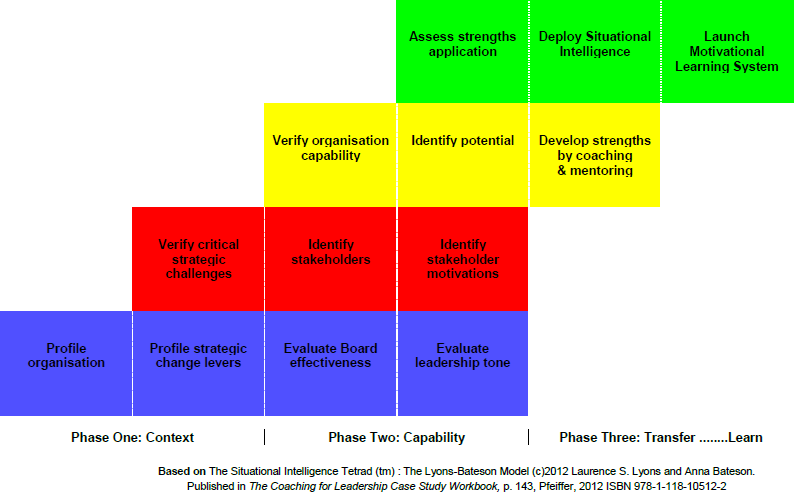
    Successful leaders agree that while formulating strategy may be difficult, ‘making strategy happen’ is the greatest challenge. Since the 1990s, the author and Dr Laurence Lyons have been collaborating to research and develop approaches to building the leadership capability necessary to address this challenge successfully.

    As highly experienced agents of change, LyonsBateson have captured important insights into the development of Situational IntelligenceTM  through their work with multiple organisations and their leaders. Based on the premise that for any event, there are a number of potential outcomes and some of these outcomes may be more desirable that others, the leader seeks to judge the most effective way to intervene in order to bring about the most desirable outcome.

    By identifying the event as a situation arising from the translation of a policy into action, the leader seeks to define the potentially impacted stakeholders, establish their motivations and engage the stakeholders in building a common agenda.  Building capability involves practice with a toolkit of critical questions which enable business leaders to reflect on and make sense of the complexity surrounding them.

    Download Lyons-Bateson SIT Summit Paper