
Now, soon and the future

Multiple research reports counsel against short term thinking and decision making in boardrooms. Regulation seeks to prevent directors capitalizing on short termism. Governance codes highlight the importance of balancing short term performance with long term stability. Working across different time horizons is recommended.

When a crisis occurs like a global pandemic, thinking beyond survival becomes more difficult. It is a brave board which sponsors significant changes in strategic direction and major investments. We will hear the stories of these brave boards, navigating their organisations through transformational change. We may hear less about the teams who enabled their informed bravery.

Behind every high performance board are professionals from many disciplines, accountable for providing intelligence to inform strategic decision making. Working in partnership with the board, they enable holistic questioning and are responsive to constructive challenges. From disciplines including corporate governance, compliance, strategy, risk, legal, internal audit, investor relations and communications, these experts enable board effectiveness.

To sustain a range of initiatives which simultaneously maximises short term survival/performance, while planning changes to the current business model and exploring innovative and transformation changes, calls for courage, imagination, stakeholder engagement and excellent programme management.

The Board’s future thinking is often overtaken by the time required to solve problems in the ‘now’ and ‘soon’. A recent McKinsey Sustainability at COP26 event predicts the emergence of ‘50 new Tesla’s’ led by innovative technologists engaging multiple stakeholders in their ambitious plans.

Beyond auditing the time investment each board makes in operational problem solving and designing the future, exploring board health and dynamics is often an effective means of identifying the quality and effectiveness of strategic thinking, decision making and monitoring. With better understanding of their effectiveness and the support of internal stakeholders, each board is well equipped to improve their strategy formulation process and outcomes.

Building Board effectiveness

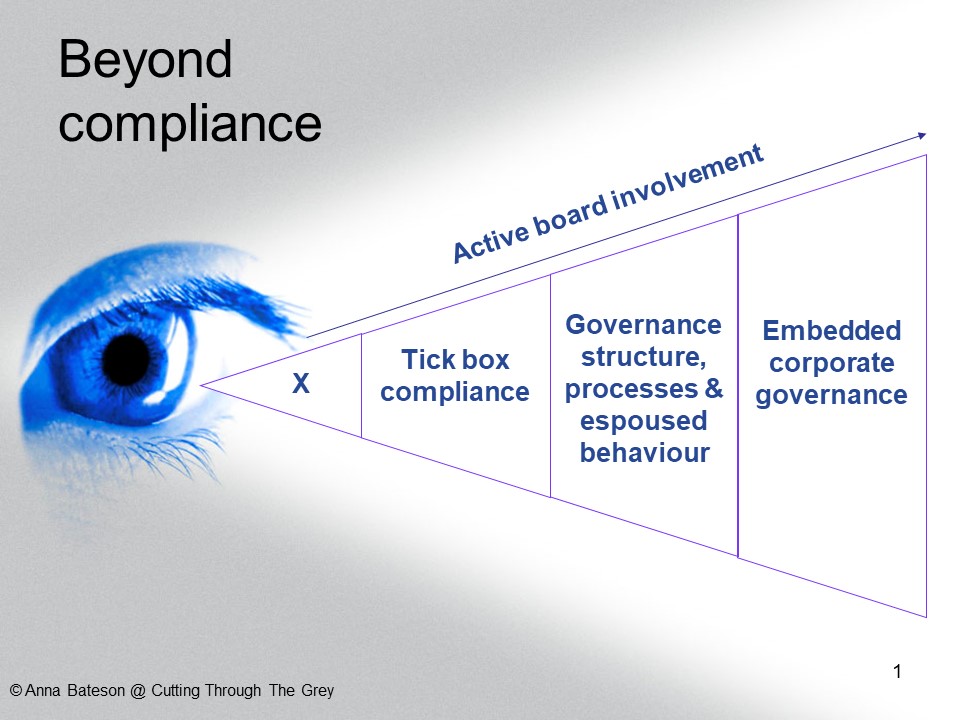
Across the private, public and third sectors, organisations are seeking support from governance professionals to do more than ensure regulatory and legislative compliance. The boards aim to deliver and be recognised for delivering governance 

Far from expecting instant engagement, it is important to work from a board’s current intentions and invest time and energy in developing collective understanding and commitment.

Some boards exist in name only at Companies House, signing annual documentation.

Other boards set their intention as compliance, investing little or nothing in a stewardship and governance agenda.

Boards with governance professional support are likely to develop frameworks, practices and codes to deliver compliance and governance.

Those boards with an intention to embed governance, recognise the significant investment of time and effort required to create and sustain common purpose and behaviour.

Working with Boards and Governance Professionals provides me with heart-warming insights into the contributions each make to building board effectiveness. Here are the three most frequently referenced ways in which they do so:

Boards 

– Value the  independent professionalism of their governance support team beyond regarding them as a mechanistic function.

– Invest time and energy to build a trusted relationship and ask for help. 

– Collaborate to co-create their governance framework, processes, practices and agendas. 

Governance professionals 

– Anticipate issues and plan approaches to avoid repeat problem solving. 

– Enable their boards to ask the right questions and listen to a broad range of voices. 

– Enable better conversations between board members based on a real understanding of what each can contribute. 

Building Better Boards

Multiple lists specify the knowledge, skills and experience that boards need in order to perform their role effectively. There is no universally applicable formula for building a better board. Good approaches suggest that establishing a framework relevant for your own organisation is the foundation for succession planning, development and recruitment of directors. Excellent approaches also provide granular strengths analysis to specify the diversity of attitudes, beliefs, thinking approaches and behaviour that contribute to board performance. 

Enabling directors to play to their strengths improves contribution. Effective Chairs recognise the different strengths which each individual could contribute and create the environment in which imaginative discussion and constructive challenge take place prior to decision making. 

The canvas of strengths is broad and complementary. For example, to deliver a robust strategic process, your board requires a range of different strengths to analyse your organisation and environment, explore different strategic options, choose a path to the future, excite stakeholders to join in that journey and track progress and performance. 

Over the last 18 months, the level of external scrutiny of strategic process, board decision-making and behaviour has increased. Focusing on one aspect – Attitude to problems – astute observers ask: 

“Where are your problem anticipators, your opportunity spotters?” 

In times of crisis, problem solvers often get most headlines. They are the individuals who are quick to act to recover difficult situations and mitigate risks. Stories are told of their success, they prosper.

Less overt are the individuals who quietly prepare plans to take advantage of strategic change, selecting the opportunities to maximise value and minimising the risks associated with the changes. 

Whether on the board or informing the board, both sets of strengths are essential. Well done to the Chairs who enable a board culture that allows both approaches to be heard and applied. Their boards invest concurrently in modifying their current organisation model, developing new models and designing innovative approaches to the emerging macro environment.

Coaching for Governance

In boardrooms around the world, members have been busy navigating the global pandemic and the multiple consequences for their organisations. Emerging from the background are the professionals who enable those boards to govern effectively. Inspirational stories are told about the contributions they have made and awards ceremonies have recognised their efforts.

Expert at planning, organising and problem solving, governance professionals are increasingly recognised for their ability to provide individual and collective support to board members. As technical experts, support is based on signposting and sharing knowledge. As enablers of governance, the ability to create and sustain trusted business relationships involves developing an ability to coach board members. From on-boarding new members to facilitating smooth succession planning and implementation, the calm, purposeful and independent presence of governance professionals is appreciated by wise board members.

Governance professionals are in a unique and privileged position to observe board dynamics and track the impact of board decisions and behaviour. Learning how to use those insights effectively is a universal development priority. Governance professionals provide value by enabling each board members to understand the impact which their own beliefs, strategic decision-making and behaviour have on the organisations they lead.

Coaching at board level enables good governance by recognising the regulatory environment, the multiple roles which individuals are required to balance and the complex dynamics involved at that level.  The potential impact that changes to decision making and behaviour can have on the whole organisation system is significant. The principles and approaches that define good governance vary globally from the rules to the principles based and the locus of power varies across unitary and two-tier boards with all the attendant complexities this brings to strategic decision making. It is therefore safe to assume that the approach which has been successfully adopted in one situation by one individual cannot be automatically translated to another.

Experienced coaches provide support by enabling individuals to explore the situations they face, the strategic context in which they intend achieving their objectives and the range of stakeholders they expect to engage. Board members refer to the value delivered by coaches, providing a highly personalised sounding board as they plan, act and reflect on their impact and results

The Chartered Governance Institute highlights the way in which excellent governance professionals coach their boards. They act as patient, objective and wise counsellors, use their insights to anticipate issues, exert subtle influence and ensure robust discussion and strategic decision making.

For an opportunity to discuss that contribution, join me at the roundtable. 

CGI Annual Conference 2021 

What we notice and how we decide

In uncertain times we rely on our judgement to make ‘good’ decisions for ourselves, our organisations and our stakeholders. Very few of the decisions we make are binary. Navigating ambiguity comes more easily to those who tolerate uncertainty. For everyone, the activity requires energy. 

Individually, our habits and experiences impact what we notice and how we decide. To audit the quality of our decision making, we are advised to consider our behaviour and associated biases. This simple health check could be your starting point:

What information do we use to inform our decisions?

We create effective board intelligence processes but find that establishing what is good data and what is noise can be challenging. Common habits such as the tendency to ignore statistical evidence (Base rate neglect) and the mechanistic default to focus on easily obtained data (Availability bias) impact the quality of our decision making. A failure to ask probing questions to enable consideration of a range of options can result in partial, filtered board intelligence. 

Boards are advised to ensure that they think carefully about the nature and scope of the questions they need the business to answer.

Whose opinions and perceptions influence our thinking?

An invisible board habit of deferring to the most powerful person in the room and attributing weight to their words in the absence of evidence, is often present during board decision making (Anchoring and Authority bias). Our challenge is to check whether undue influence is being exerted by individual(s) with more authority/ power than us. We must be prepared to challenge statements to establish the intelligence on which others have based their opinions.

Other habits which draw us towards specific sources include our desire to create certainty where none exists and the inclination to filter out sources that disagree with our hypothesis (Confirmation bias). We like to belong to tribes and may want to fit in with the majority view, joining the bandwagon (Social Proof). However, most popular is not better or best and viral news can be false.

Boards are advised to create cognitive diversity in their decision-making forums.  When participants are encouraged to constructively challenge and express their alternative views, the quality of decision making improves.

How much does our experience hardwire our choices?

Our intuition may lead us to advocate or defend decisions and actions despite the absence of evidence.  Just because it worked for us before, does not mean it will this time. Our belief that because we have already invested resources we must continue with an initiative, may be flawed (Sunk cost fallacy). We believe we are adept at predicting the future and our arrogance can cause us to take uncalculated risks (Hindsight bias). If the experts we have invited to contribute have provided what we want to hear, then they reinforce our own views of what we think we know (Overconfidence effect).

Board members are advised to make a record of their experience and predictions in order to have a basis for reviewing their accuracy.

Leading in unprecedented times

As we travel through unprecedented times, multiple authors provide checklists for leaders. They recommend mindsets and behaviours. The lists are long and may tempt us to focus on those we are missing. Instead, it might be more fruitful to understand our strengths and how we can deploy them appropriately. We can collaborate with other people whose strengths complement our own.

In January, MITSloan Management Review published research into the future of leadership entitled The New Leadership Playbook for the Digital Era. Defining leadership behaviours as eroding, enduring and emerging, the 24 behaviours reinforce the long term trend away from a planned and directive style towards an emergent and empowered approach. The research highlights the importance of developing the mindsets in which leadership is shared and individuals think like producers, investors, connectors and explorers to succeed in the digital economy.

In March, Eric McNulty writing for Strategy + Business urged that we put away the cape and tights of superheroes and focus on human behaviours. He recommended expressing genuine concern for those affected and creating the space and climate where collaboration, compassion and service are rewarded. Navigating with your moral compass and ensuring that values and ethics inform your decisions will engage those around you. His warning about avoiding decision fatigue is a powerful reminder that we need to take care of ourselves.

In June, Cappfinity CEO Alex Linley reminded us of the importance of listening to our whispered voice in order to understand our strengths.

It is this combination of doing something well, something we are good at and that also being something we enjoy, that is energizing, something that we love to do, that is the authentic essence of a strength”.

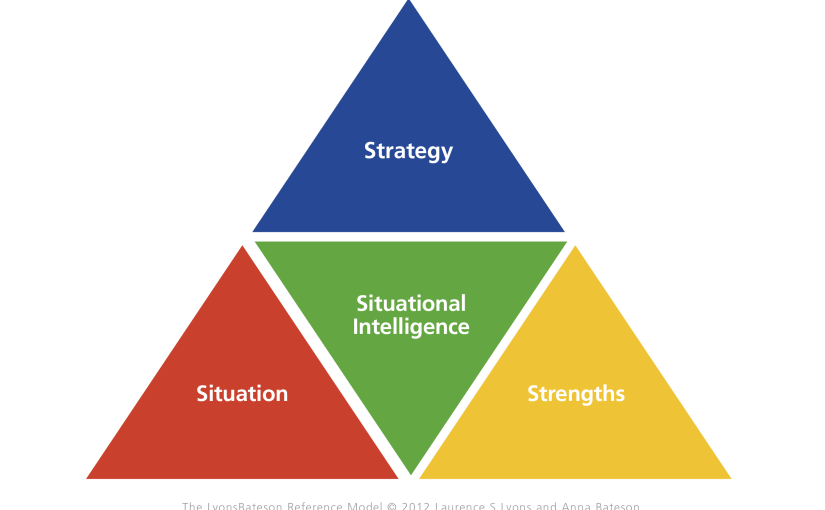
Leading in these challenging times requires Situational Intelligence and energy. It is easy to become exhausted balancing multiple conflicting demands on our time and attention. This advice might help us make more time to do those things that make our hearts sing:

Making time to recharge our batteries is important.

Understanding our own strengths will enable us to deploy them effectively.

Focusing on our achievements together will enable us to build resilience.

Applying Situational Intelligence

In a world where existing knowledge is codified and available for those who know where to look, a spirit of enquiry is a strength worth cultivating. And now we have time.

The global pandemic provides periods of frenetic activity interspersed by periods of reflection. This ‘black swan’ event has been on the risk: impact maps of futurists for some time but we don’t always pay attention to voices that don’t share our world view.

Now is certainly the time to gather intelligence, anticipate, plan, respond and re-plan in continuously evolving circumstances.

The search for intelligence which provides certainty may be rather fruitless. Innovative thinking and imagination can appeal as we all seek solutions to universal problems. Collaborative thinking may not respond quickly enough, but conversation is critical.

Now is also the time for kindness and gratitude.  

Over the past two decades of running Cutting Through The Grey, I have been fortunate enough to work with thousands of business leaders and governance professionals from across the globe. Building trusted business relationships has enabled individuals, boards and their organisations to realise the greatest value from our activities together.

In the last 100 days, clients, colleagues and friends have generously contributed their insights to Situational Intelligence stories we have been developing and I am grateful for their time and energy. Together we are creating a different way of thinking.

A robust strategic process

Increased scrutiny by a range of interested stakeholders is prompting many boards to explore how robust their strategic process is. For listed entities, regulators require evidence of compliance and have extended their interest to incorporate a broader governance agenda. Positioned as good practice for all, the agenda has been tailored for large private companies into the Wates Principles. For public and third sector entities, standards bodies provide inspection regimes.

Investors expect to make informed choices and seek assurances that they have a true and fair picture of organisation performance and aspirations. Talent is attracted to organisations that clearly position their strategic intentions and report on their delivery. 

When health checking their strategic process, boards may choose to consider the following: 

Inputs – board intelligence 

Specification  – asking the right questions and requesting the exploration of alternatives.

Collation – triangulating sources to increase confidence and including big data and human intelligence. 

Clarity – ensuring that assumptions are explicitly stated.

Process

Timing – building on the board rhythm. 

Urgency – determined by the level of dynamics in the wider world and market places

Order – sequencing activities to recognise appropriate involvement and sustain focus and momentum through time.

Involvement – building engagement through conversations between horizon scanners and those with operational insight. Ensuring respect for different perspectives and perceptions. 

Outputs – decision and tracking 

Aspiration – developing a storyline to explain the journey to the future.

Evidence – showing how decisions have been arrived at.

Metrics – choosing the few lead strategic metrics which will clearly show progress and behaviour.

Most critically, a robust strategic process requires the commitment of all members of the board and the teams who enable them to govern effectively. It takes time to align individuals and build common purpose. Failing to ensure that alignment before health checking your process will deliver flawed results.

True ‘Customer’ insight

True ‘customer’ insight  is a hot topic around boardroom tables, but often subsequent to a review of financial performance.  Strategic thinking involves understanding the perceptions and intentions of many stakeholder groups in order to create value propositions and engagement strategies. Failure to deliver perceived value to ‘customers’ tends to negatively impact the ability to deliver value to any other group of stakeholders. 

Who is the customer?

The first challenging question.  Determining who you want to provide value to may involve modifying the market segments you target. Identifying the customers you don’t want to serve is also critical. Consider inviting these elegant but invasive Green Parakeets into your garden and watch the small birds leave.

Who knows?

Decisions on who to target need to be informed by evidence so critical questions include ‘ how can we hear our customers first hand? And ‘who knows the history, perceptions and intentions of each customer?’

Who listens?

Consultancies and academic researchers have advocated an increased exposure of executive committees and boards to customers who reinforce organisational beliefs AND those that challenge assumptions. Listening to perceptions first hand can be educational but also uncomfortable.

Boundary workers with unique insights to share need to be invited to speak directly to strategic decision makers and supplement the real voices of customers. The voices of those who know may be filtered out before they reach the boardroom. 

Reliance on Big Data without the addition of human intelligence can lead to misinformed strategic decision making. Sifting messages from noise and recognising patterns is a critical board competence. 

Creating opportunities to listen to customers and boundary workers may require ‘Leading by Wandering About’ as opposed to MBWA (Managing by Wandering About). Physical and virtual wandering about are habits cultivated by effective directors and enabled by governance professionals.

What happens 

If you engage in conversations with customers, you build an expectation that change will happen. You also build an expectation that the conversation will continue. This presents challenges in establishing who is responsible and accountable for deciding and delivering changes and how performance and perception of value delivery will be monitored. 

Ensuring that change is visible and supported by necessary hard wiring and soft wiring of your organisation involves adopting systems thinking, understanding the inter-connectivity of all parts of your organisation.

Establishing which stakeholders are consulted before strategic decisions are taken and which stakeholders are informed after decisions are made, provides the foundation for an effective engagement strategy. 

So now after a year of courting a charm of Goldfinches to our garden, I am off to persuade the Green Parakeets to move on.

The Brand/Reality gap

Teflon leaders. Toxic cultures. Tribal behaviour.

Trust dissipates. Reputations tumble. Performance in trouble. 

But how long does the impact last and are lessons learnt to prevent repetition? 

Regulation and legislation may be a blunt and slow instrument for dealing with systemic dysfunction. 

New leaders emerge to deal with the mess, and so we go on. 

Self interest and the loss of contact with reality seem to define so many stories.